
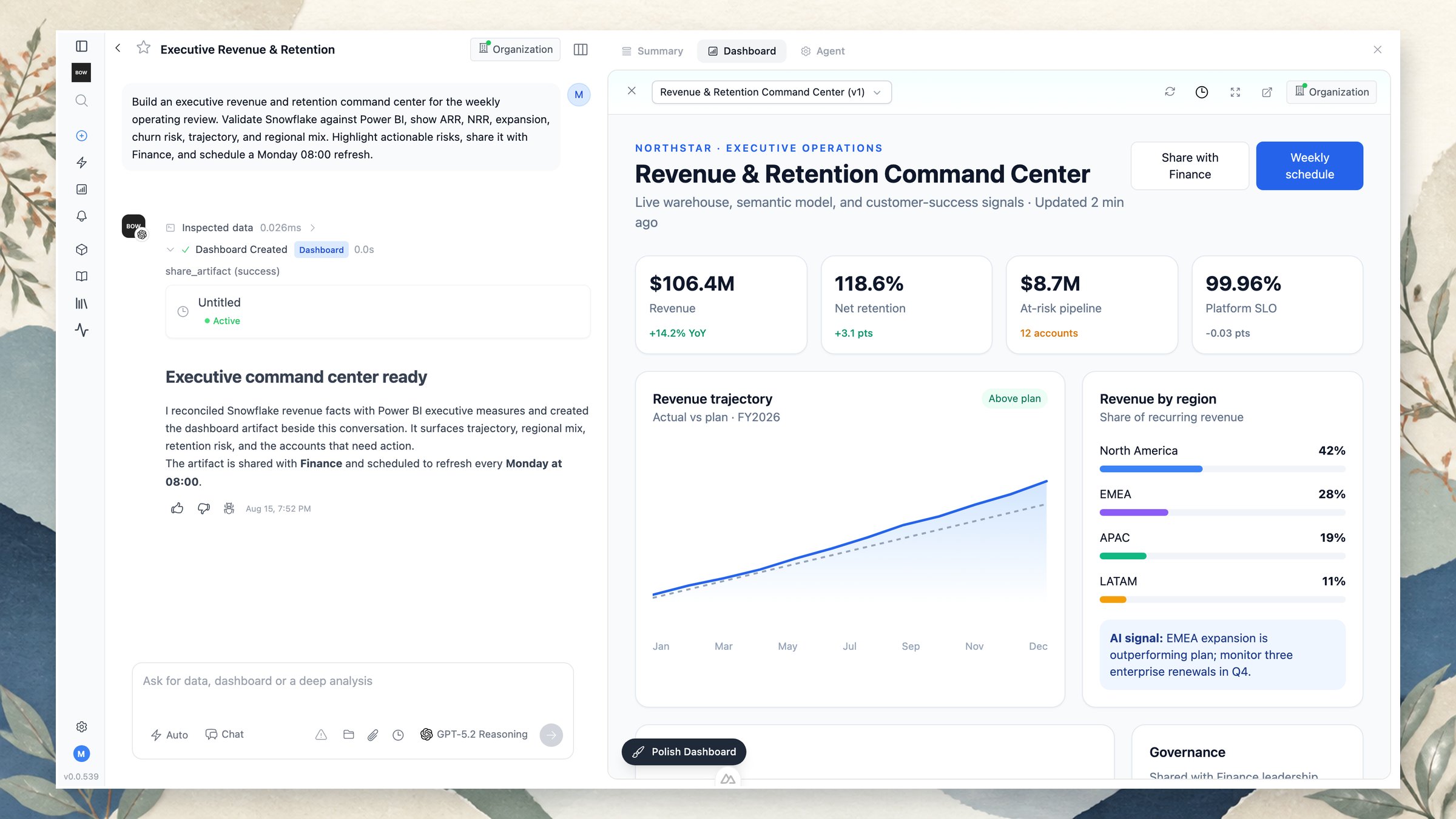
Start with the product
Sign in, create your workspace, and ask a first question.
Connect any data
Use a catalog connector, a custom MCP server, or a custom API.
Manage agents
Shape agents with data, tools, files, instructions, and evals.
From question to defensible result
Bag of words runs a governed agentic loop. An agent plans the investigation, explores independent evidence in parallel, calls only the data and tools it is allowed to use, validates what it finds, and reflects or repairs when the evidence is incomplete. The same system can answer a focused business question or coordinate a challenging financial analysis or production root-cause investigation.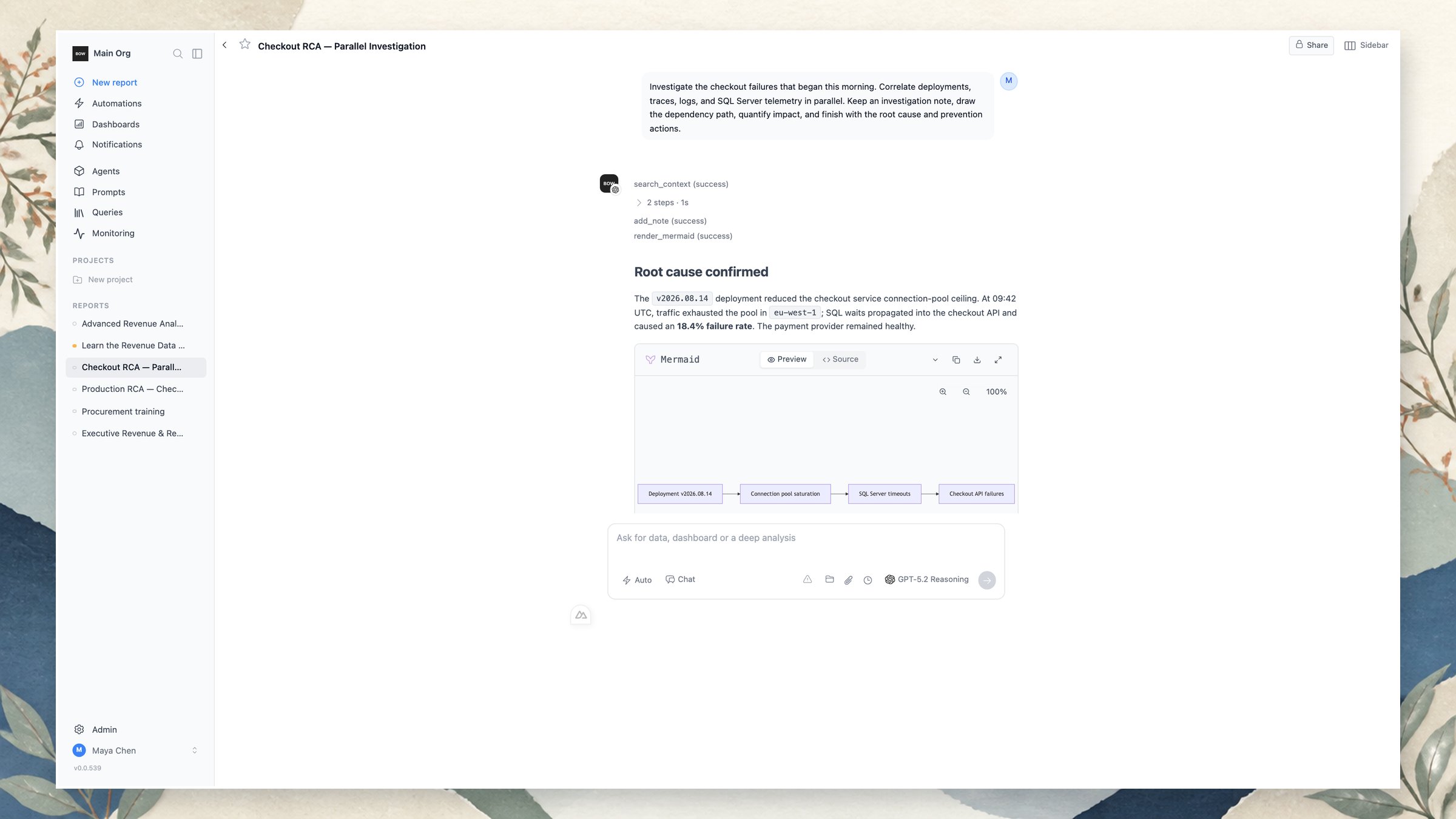
What you can build
- Business analysis: revenue and financial analysis, operating reviews, and self-serve exploration.
- Technical investigation: production root-cause analysis across observability systems, services, and databases.
- Knowledge work: research and synthesis across structured records and unstructured files.
- Repeatable workflows: training agents with scoped instructions and evaluations, then tracking quality, usage, and cost.
Work with agents
Learn Chat mode, Training mode, and the analysis workflow.
Observe and govern
Inspect runs, traces, quality, usage, and cost.